The Tech Deal series - 4. ARR valuation: negotiating the definition

With no standard to measure against, ARR is more negotiable than it looks
Where the series has been: Post #1 set out what sets a technology transaction apart from an ordinary M&A deal. Post #2 focused on the LOI and discussed what to lock down before the SPA in tech M&A. Post #3 put the valuation question to a private equity investor, Julia Beij of Smile Sail, on how a purchaser arrives at a number for software and AI targets and what moves it afterwards. This post discusses how you build and negotiate the purchase price, because where the price is a multiple of ARR, the definition of ARR is the price.
Hand two independent analysts the same software company and ask each for its annual recurring revenue (ARR), and you can get two materially different numbers. One counts the usage-priced AI assistant at Nevelo, the Dutch B2B SaaS scale-up this series follows, as recurring. The other counts only the part each customer has contractually committed to. Neither is necessarily wrong. They are answering a question that has no standard answer, and it is one of several when determining a company’s ARR. Include Nevelo’s €750,000 of usage-based revenue at a multiple of eight, and the two answers sit about €6 million apart in enterprise value. Because ARR has no uniform definition, it is a figure you build, and whoever builds it is setting the price.
Why revenue, not earnings
A growing software company spends its margin on winning customers, so pricing it on a multiple of profit punishes the thing the purchaser is paying for. The market prices the revenue instead, or more precisely the annual run-rate of the recurring part of it. There is no established market practice for measuring that run-rate, which turns it into a negotiation whenever ARR is the agreed metric.
In 2023 Ordway, a billing-software vendor, reviewed how 136 SaaS, cloud and fintech providers listed on the NYSE and NASDAQ report the metric. Half gave a definition for it, and of those 68, 55 had adopted a policy or formula of their own. The study groups the choices into eleven categories, and none of them is marginal. This post later zooms in on the main categories that build the ARR number and which approaches parties can take when negotiating the definition.
Determining the enterprise value: ARR and the multiple
A target’s enterprise value is the ARR times a multiple, and the two halves come from different places. The multiple is set by the market and is usually not a term the lawyers negotiate. Where the multiple for a particular company lands turns on its overall attractiveness, which weighs customer retention, the depth of the management team and market position alongside the numbers. Asked in Post #3 which metric is decisive in practice, Julia Beij, investment manager at Smile Sail, named growth combined with the margin that can ultimately be realised. This post uses a multiple of eight, a deliberately illustrative premium case. At eight, every million euros of revenue that moves in or out of the ARR definition moves eight million of enterprise value.
ARR: six definitional elements
SaaS operators track the metric as a movement: last period’s ARR, plus new and expansion revenue, less contraction and churn. Every building block of that figure is a definitional choice dressed as a calculation. Six are worth watching on the next software target priced on ARR.
Which revenue counts as recurring
Subscription fees, yes. Implementation and onboarding fees, professional services, training and one-off licences, no: they are real revenue, but they do not recur, and annualising them inflates the base. Committed support and maintenance under a perpetual licence does recur, which is why an on-premise software house with a large maintenance base is in this conversation too.
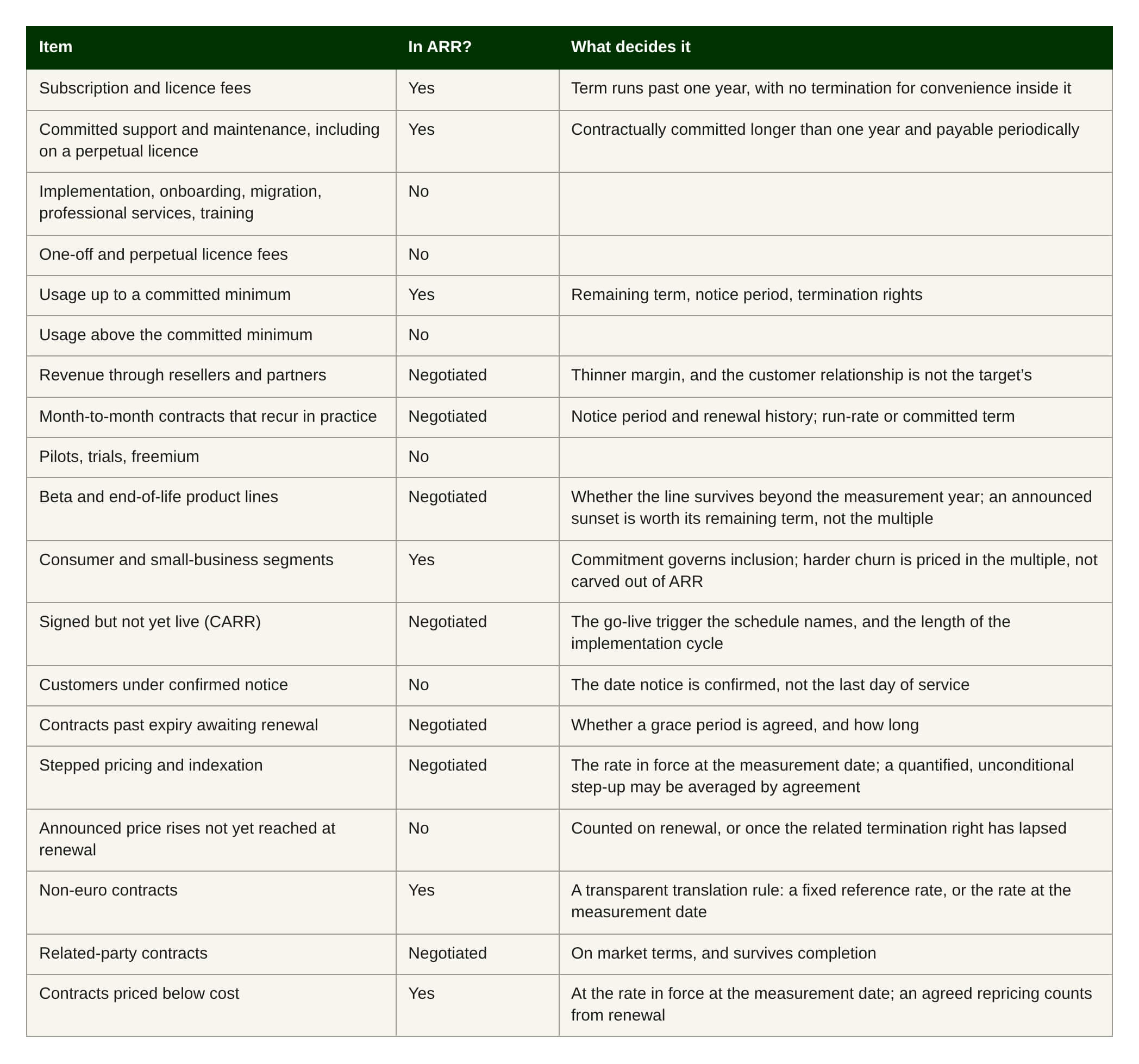
The contract type grades the answer, and so does where the product sits in its own lifecycle; the table at the end sets out the gradations. In a tech M&A deal, sellers will reach for the broadest version, purchasers tend to price the narrowest.
Contract length is the first of those gradations, and there is no market standard for it. The 2023 study found practice split: some providers count month-to-month subscribers as long as they keep paying, others exclude month-to-month and pay-as-you-go accounts altogether. The threshold is therefore a choice the parties make rather than one they inherit. The defensible line is a committed term of at least a year that cannot be terminated for convenience inside it, which is what the word annual in annual recurring revenue is doing: a contract committed one month at a time lets the customer walk whenever it likes, whatever the billing says. That puts month-to-month outside the number by default, and a seller whose cohort data shows those customers actually stay can argue them back in, where the comfort comes from evidence rather than from the contract.
The live edge is usage. Nevelo’s AI assistant is billed by the volume of assistant queries rather than per user seat, so the revenue arrives every month, which feels recurring. Whether that makes it recurring is the whole debate. The workable answer is a line drawn through the middle: where a contract carries a committed minimum, the revenue up to that floor is recurring and everything above it is not. That is not a drafting invention; the Ordway study names listed issuers that exclude overage above the contractual minimum from reported ARR. It is also the rule sellers resist hardest, because in a growing account it is precisely the part above the floor that grows, and that part is excluded.
The rule has a second-order effect: sellers who learn it start writing committed minimums into contracts at the renewals before an exit process, converting uncommitted usage into recurring revenue at the stroke of a pen. What matters is how the commitment came about, and whether it holds. A floor agreed with a customer that was going to consume that much anyway is housekeeping; a floor pressed on one that did not want it buys a year of revenue and hands that customer a reason to leave at the next renewal. Then the mechanics: how much of the term is left, what notice the customer can give, how wide the termination rights are. A floor agreed last quarter on a contract the customer can exit in thirty days is worth less than the same floor with three years to run, which is what a prudent purchaser tests in diligence.
The Ordway report also shows listed companies removing SME customers because that segment churns harder. A committed contract with a small business recurs as surely as one with an enterprise, and deserves its place. It is cleaner to price harder churn in the multiple than to carve the segment out of ARR.
Contracted but not live
In software there is often a gap between signature and go-live: implementation, data migration, integration with the customer’s own systems, security review and the customer’s own readiness. A signed contract that has not gone live is conventionally kept outside ARR and reported separately as CARR, contracted annual recurring revenue. Whether and how it is priced is a negotiation: it is committed revenue, but some of it never goes live at all. Implementations stall, customers cancel during onboarding, and in enterprise and public-sector work a project can be deprioritised indefinitely.
How much that is worth arguing about depends on how long the business takes to switch a customer on. In mid-market SaaS it is weeks and the gap is trivial; in enterprise or public-sector software it runs to six or twelve months and can be material, which is where the go-live rule and the measurement date start to matter.
The measurement date and annualisation
ARR is a snapshot, so the date matters. So does the route from observed revenue to an annual figure, the choice most schedules leave unspoken.
Most ARR statements are built from the bottom up: take every contract live at the measurement date, annualise the committed periodic fee under each, add them together. Nothing is extrapolated: the contract already states the rate, so annualising it is a calculation, not a projection. The shortcut appears where contract data is harder to pull than billing data, and above all where revenue is usage-priced and no contract states an annual figure at all. Ordway found the listed providers in that position annualising historical revenue instead, typically the trailing month times twelve or the trailing quarter times four, which assumes that period is representative of the year ahead. A third approach divides total contract value by the months in the contract, which carries any one-time implementation fee straight into the annualised figure unless the schedule says otherwise.
Whichever route is taken, the schedule should name it: that ARR is derived contract by contract from the source systems as at the measurement date, and that where any part of it is annualised from observed revenue, the period drawn from and the revenue types it may contain are specified.
Churn
Churn has to leave the count when it is known rather than when it is convenient, so a customer that has given notice is gone on the day the notice is confirmed, whatever the invoicing calendar says. Some providers run a contract past its expiry on the expectation of a late renewal, which is a choice that has to be made in the open.
The same annualisation choice applies to churn: trailing twelve months smooths a bad quarter away, the last quarter annualised makes it decisive, and neither is wrong as long as whose number it favours is clear.
Quality adjustments
Four adjustments change not whether revenue recurs but how much of it is counted.
A contract priced to step up in later years is annualised at the rate in force at the measurement date, not the rate it climbs to, unless the step-up is quantified, committed and unconditional, in which case a seller may well argue for the multi-year average. A contractual indexation clause counts only from the date it applies, the indexation figure being unknown before then.
An announced price rise sits on weaker ground still than an unconditional, quantified step-up. A committed minimum or indexation clause is something the customer has signed; an announced increase is something it has yet to accept. Booked into ARR straight away, it counts revenue the customer may renegotiate or leave over, so it belongs in the number only as each contract renews onto it, or once the related termination right has lapsed.
Contracts in another currency need a transparent translation rule, either a fixed reference rate named in the schedule or the rate at the measurement date, so a favourable exchange move does not pass for organic growth.
And related-party revenue counts where it is on market terms and survives the transaction, and comes out where it fails either test.
Whose numbers govern
The last element is not about what is inside the ARR number but about how you get there. It is the one most ARR schedules leave out, and in practice it affects the other five. Which system is the source of truth: the billing platform or the finance ledger. Which accounting policy applies, and whether it is the one applied last year. Who prepares the ARR statement, and what happens when it and the billing system disagree.
Much of this surfaces in financial due diligence rather than across the negotiating table, which is why it is worth pinning down before diligence starts. The purchaser will review the figures that drive the number; the schedule settles in advance which of them the ARR statement is built from, and by whom.
Risk that belongs in the deal terms, not in the number
Some risks belong in neither the ARR definition nor the multiple. A multi-year contract carrying a change-of-control termination right stays in ARR, because the revenue is committed, even though the transaction itself may be what makes the customer leave. Shaving the multiple is no answer either: it spreads one contract’s exposure across every euro of the base, and the discount stays in the price even if the customer stays on. Risk tied to named contracts belongs in the deal terms: customer consent as a condition precedent, a price deduction for the exposed contracts, a contingent part of the price, or simply accepted as the purchaser’s risk. The SPA posts later in this series return to it.
When ARR disputes end up in three forums
The best protection against a purchase price dispute is a definition written out in full and tested once against a worked example before signing. Even that is no guarantee. An ARR dispute can be tricky on two fronts at once: what the number should be, and who gets to decide what.
Most SPAs split that second question the same way. The calculation goes to an independent expert, usually an accountant acting as bindend adviseur, whose determination binds the parties. Everything else goes wherever the parties chose for disputes generally: the ordinary courts, arbitration, or the Netherlands Commercial Court.
Calculations to the accountant, law to the lawyers. On the page the division looks obvious. It is not: the expensive disputes mix both, and the clause rarely says who has the final word over the mix.
The line was drawn in 2014 (Amsterdam Court of Appeal, interim relief appeal, 21 October 2014, ECLI:NL:GHAMS:2014:4342). A Dutch share sale on completion accounts, an initial price of €1.5 million, and a final-price adjustment the two sides put €55.7 million apart, most of it from treating accruals and provisions as net debt rather than as working capital. The seller was not asking the accountant to apply an accounting standard differently: it argued the parties had agreed to treat those items a certain way whatever the accounting principles required, which makes the question what the contract means, not how to calculate a figure under it. The Court of Appeal held that a question of that kind is one of construction: it belongs to the court rather than to the reporting accountant appointed to settle the accounts, and an expert who answers it anyway exposes the determination to annulment under Section 7:904(1) of the Dutch Civil Code.
Well-drafted agreements now build that distinction in, and a judgment of September 2026 shows how strictly it is held (Rotterdam District Court, interim relief judge, 23 September 2026, ECLI:NL:RBROT:2026:12508). An earn-out of up to €3 million on a €7 million software deal turned on a defined revenue metric, with conversion rules for customers moving from a licence to a subscription. Disputes went to NAI arbitration, the earn-out calculation was carved out to an accountant as binding adviser, and the clause required him to apply the defined terms. When his draft determination construed them instead, the purchaser suspended the binding advice and filed for arbitration, and the seller came to court to have it resumed. The court refused. The parties had evidently thought their own definitions good enough to be applied rather than construed, so interpretation stayed outside a carve-out which, as an exception to an arbitration clause between advised professional parties, fell to be read narrowly. An accountant, the court added, lacks the legal expertise interpretation calls for.
Then came the consequence the drafting is meant to prevent. The SPA sent seller and purchaser to arbitration, but the expert’s engagement letter carried no arbitration clause, so the dispute with the expert went to the civil court instead. One defined term was now live in three places at once: the suspended binding advice, the purchaser’s arbitration, and the seller’s court claim, and if the arbitrator read the term differently the binding-advice process would have to be run again. Two years after the purchaser shared its earn-out calculation, the parties were still arguing about the mechanism, and nobody had a number. An ARR dispute is the same species: for example, whether committed minimum usage revenue falls inside the definition sounds like a number and is a question about what the words in the schedule mean.
What these two cases have in common is that the problem sat in the expert’s engagement letter: in 2014 a seller who would not sign one, in 2026 one that left the expert outside the forum the parties had chosen for themselves. That is why I reserve questions of construction to the court or the arbitral tribunal in the SPA, at signing. Once a dispute arises and an expert is appointed, I check the engagement letter against that reservation before it is signed, to make sure it submits the expert to the same forum rather than opening a second track. What I deliberately do not insist on is a mandatory pause the moment either side calls a point legal, since that would let either party unilaterally freeze the process. Left open, the expert can carry on where the point is peripheral, while the parties can still agree to pause where it is not.
Building the ARR definition schedule
Go back to the two analysts from the start of this post. The reason they can hand you numbers €6 million apart is that nobody wrote down the rules before they started counting. Run all six elements across the same base and the two answers finish €22.4 million apart. An ARR definition schedule is how you write the rules first: inclusions, exclusions, the measurement date and the annualisation basis, churn treatment, quality adjustments and the source of truth, annexed to the agreement so that the ARR statement the price runs on is prepared under agreed rules instead of being contested after signing.
Agree it as early as the parties will bear. Put the outline in the letter of intent, where Post #2 put the half-page version: the multiple is still open there and a definition costs little to concede, whereas once the price is fixed as a multiple of the seller’s number, every exclusion reads as a price cut. Refine it against the data room in diligence, then annex the agreed version to the SPA, so one schedule governs the price mechanism, the warranty on the ARR statement and any earn-out running off the same metric. Agree the ruler before you measure, and the next target you price will not come down to which analyst you asked.
The table below sets out where each item typically lands and why. The rows marked Negotiated are where the leverage is.
You have built the ruler and taken the measurement, and the number you are holding is enterprise value, not money in anyone’s pocket. In The Tech Deal series’ next post: the bridge from that figure to what the seller actually walks away with, and the tech quirk that makes the journey longer than it looks. About a third of Nevelo’s ARR is sitting on its own balance sheet, as customer cash collected for service it has not yet delivered.